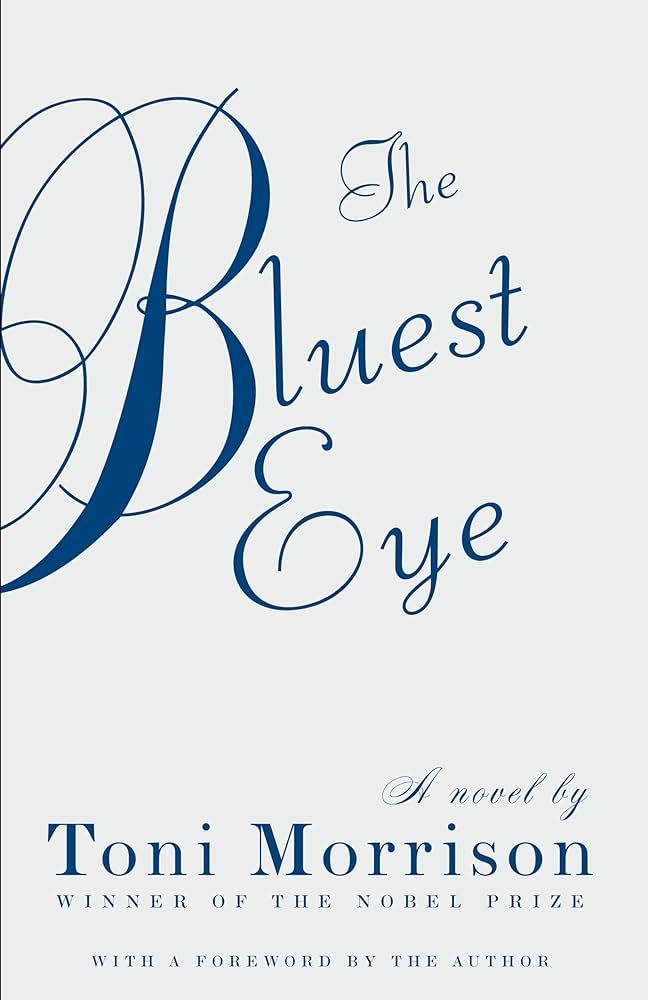
Summary: The Bluest Eye is a novel about Pecola Breedlove. An 11-year-old girl who fervently wishes for blue eyes. The Bluest Eye was Morrison’s first published novel.
Trigger warning: Violence, Sexual Assault, and Assault
Spoilers ahead
I can’t say I remember why I wanted to read The Bluest Eye. I bought Beloved many months ago with the hope of reading one of the greatest literary works of our time. I read a couple pages and got confused by the way Morrison tells her stories. Her prose wasn’t quite familiar to me yet. Our meeting would have to wait another day. Enter, The Bluest Eye. I actually listened to the audiobook format of the novel. I liked it better that way because it was Toni Morrison narrating the novel herself. Her light, airy voice was smooth as she read word after word. Never stuttering. Never hesitating.
The novel begins in the point of view of Claudia MacTeer. Claudia is a 9-year-old girl who lives with her sister Freida, her mother, and her father. She is outspoken and passionate. Claudia and her sister often feel shut down by the adults in her life. Speak when spoken to, a child should be seen, not heard. This way of thinking doesn’t damper Claudia’s thoughts. It more or less ignites them. The season is autumn when Pecola starts living with the MacTeers. Pecola’s father Cholly, set their house on fire. Pecola is a quiet and reserved girl. She has never been outspoken and she has never been passionate about most things. The only thing Pecola is passionate about is having blue eyes.
Pecola Breedlove was born into discomfort. She was never comfortable or loved in her life. Everyone saw her as ugly, slow, dim-witted, dirty, and subhuman. Pecola has never known true love. The only love she gets shown is from the prostitutes that live above her. The love they showed her wasn’t love at all really. It was a negative type of love. The kind that starts a vicious cycle of hopelessness and despair. Pecola wishes for blue eyes because she notices how little white girls are treated with blue eyes. They’re always comfortable, clean, pretty, and loved. The exact opposite of Pecola.
Pecola goes back to living with her family in the winter. This is where we start to learn more about Pecola’s family. Her mother Pauline, her father Cholly, and her brother Sammy. Pauline and Cholly physically and verbally abuse each other. Their house is one of hate. Love is devoid of the Breedlove’s and they damn themselves when they seek it. Pecola’s and Pauline’s relationship isn’t loving or nurturing. It seems like Pauline sees her children as a nuisance. Sammy always runs away to try and escape his family, and Pecola refers to her mother as “Mrs. Breedlove.” The only time Pecola sees her parents get along is when they have sex. Even then, such an intimate act is almost painful when her parents do it. Pauline lays there as Cholly grunts as if he’s in pain. Pecola has never been loved.
Pecola goes through many traumatic incidents in the book. All of these made her wish for blue eyes even more. None of these events, however, stack up to the sin of her father. Cholly rapes Pecola. I won’t go into detail, but she ends up pregnant with his child. Pecola was forced against her will and somehow, it was her fault. This incident was the final straw for Pecola as she sought out Soaphead to grant her wish for blue eyes. He does “grant” her wish, but it’s at a cost. Soaphead tricks Pecola into killing an old dog for her to get her blue eyes. Pecola finally gets her blue eyes, but it’s at the cost of her sanity. She loses her baby and she wonders around searching for eyes bluer than hers. Claudia and Freida tried to help her in their own way, but they couldn’t. Pecola’s story ends in a heartbreaking manner.
Upon finishing this book, I had to take a breather. My heart bleeds for Pecola. She was never allowed to be a little girl. From the moment she was born, she was never loved. She wished for the impossible for basic humanity to be shown to her. I saw a lot of myself in Pecola. The self-hate, the doubting, and the societal pressures of growing up as a black girl. Pecola’s tale is a tragic one, but it made me appreciate Morrison’s work even more.
 Haley's book look
Leave a comment